Air Supply: Inside Munson Healthcare’s groundbreaking drone pilot program
March 2026
Three: That’s the number of hospital systems in the United States with “active research projects” investigating the viability of drones for efficiency gains and improved patient outcomes. One of them is in Traverse City.
So says Tracy Cleveland, vice president of supply chain for Munson Healthcare and one of the key players involved in Munson’s drone delivery pilot program. Announced in 2024 and officially launched last spring, the program is exploring the potential benefits of using advanced air mobility, or AAM, technology for medical logistics in rural Michigan.
The year 2026 will mark the biggest milestone yet for that project, as it moves through new phases that will put more aircraft in the skies and test beyond-visual-line-of-sight (BVLOS) flights. If all goes well, this year’s trials could serve as a proof-of-concept for wider use of drones in the healthcare field – not just at Munson, but at other hospital systems all over the country.
A collaborative ecosystem
Telling the story of how the pilot program was born, Camille Hoisington, vice president of ecosystem development for Traverse Connect, says it “all came about because Traverse Connect has a long-standing relationship with the Office of Future Mobility and Electrification (OFME) at the Michigan Economic Development Corporation.”
According to Hoisington, the OFME approached Traverse Connect a few years ago with a proposal. The office had recently contracted with Newlab, a technology incubator in Detroit, “to do some feasibility work to see where drones and AAM technology could be deployed across the state, and for what types of use cases.”
Funding and strategic partnerships
Armed with $689,500 in grant money from the state’s new AAM Activation Fund (the state kicked in an additional $950,000 last year), Traverse Connect became the regional implementation partner for a pilot initiative testing the use of drones to deliver medical cargo and supplies between Munson Healthcare facilities.
Other partners include Blueflite, the Brighton-based original equipment manufacturer making the drones for the project; and DroneUp, a Virginia-headquartered company that is handling the “day-to-day execution,” including the actual piloting of the drones. Finally, the Central Michigan University Rural Health Excellence Institute is participating as an “evaluation partner,” monitoring the project and collecting data.
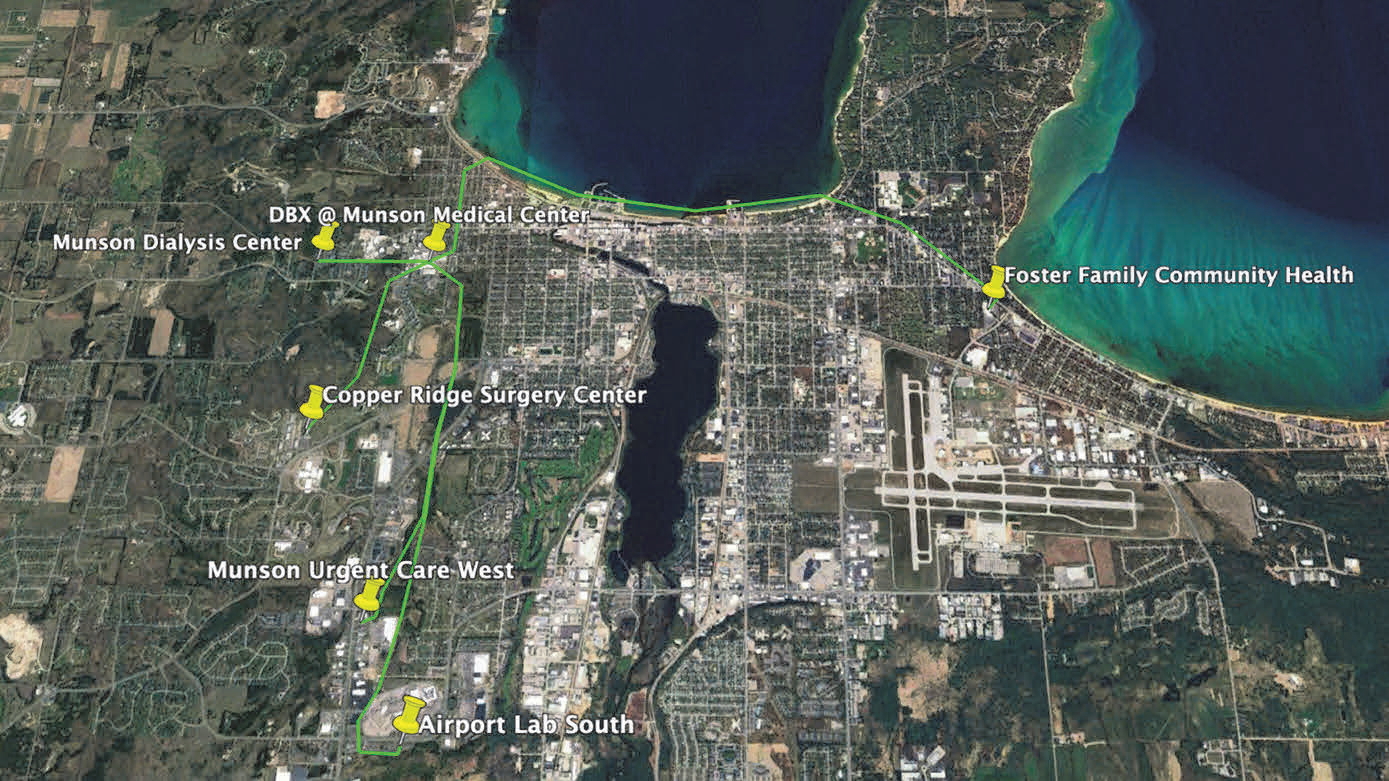 A map of Munson facilities in Traverse City, including the three included in the initial pilot study for the new drone program.
Success in a one-mile radius
So far, the project has yielded 67 test flights, all of which occurred last spring between May 9 and May 20. Per a phase one report published by Traverse Connect at the end of 2025, that 11-day test was all about evaluating “the feasibility of using uncrewed aerial systems (UAS) for transporting patient laboratory samples between Munson Healthcare facilities within a controlled Visual Line of Sight (VLOS) operational framework.”
All 67 flights were contained to a one-mile radius of Munson Medical Center, or MMC, with drone pilots executing sample deliveries between MMC and two other nearby facilities: the Munson Dialysis Center and the Copper Ridge Surgery Center. The report ultimately indicated a 91 percent success rate and noted that the drones were able to maintain payloads at an average of 17.3 degrees Celsius, well within the required range for clinical laboratory specimens.
Defining success and overcoming deconfliction
“The 91 percent success rate is even a little bit deceptive, because we didn't fail,” Cleveland said, noting that there were no drone crashes and that “failed” flights mostly involved drones that had to return to their origin to get out of the way of incoming helicopters or other aircraft.“
In those cases, the flights didn't really fail because our deconfliction protocols worked,” Cleveland continued. "From a learning perspective, we proved that the drone delivery system is a viable option for carrying laboratory samples from one place to another. That was an enormous step forward, even though it was just one-mile flights.”
Regulatory hurdles
Phases two and three, which will occur back-to-back this spring, will extend the length of the test flights into BVLOS territory. Currently, BVLOS drone flights are highly regulated and restricted by the federal government. As such, the project partners will need special waivers to proceed with the next two phases.
“We are still awaiting all of the pieces on the regulatory side, in order to set the hard dates,” said Katherine DeGood, Traverse Connect’s director of marketing and communications.
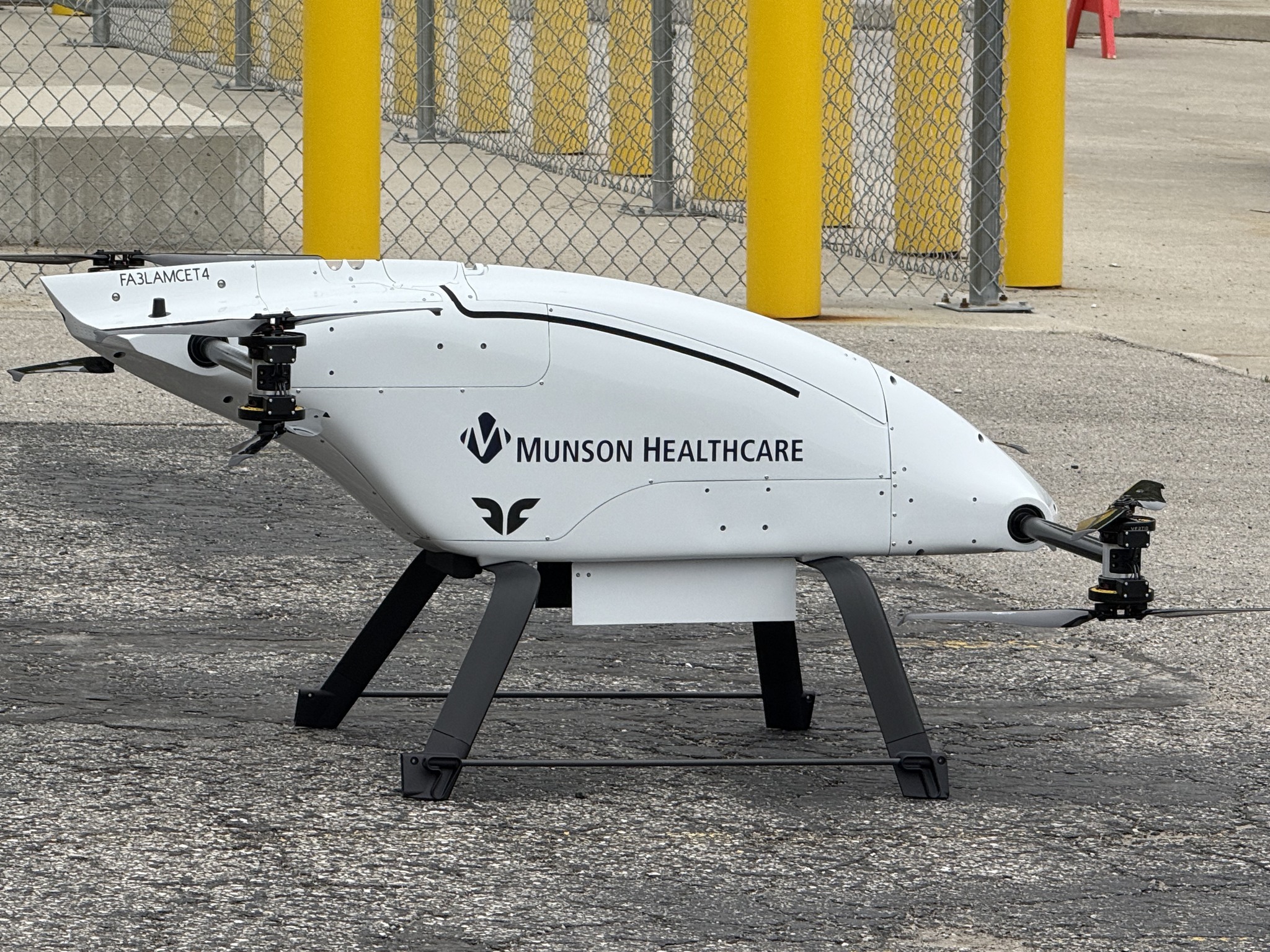 A Munson Healthcare drone, designed by Blueflite.
Logistics of patient care
The potential gains are big for Munson Healthcare, which has eight hospitals and spans 14,667 square miles in 29 different counties. All told, the hospital system serves more than 540,000 residents. According to the phase one report, Munson employees drive approximately 90,000 miles every year to transport lab samples between facilities.
"At the end of the day, what we're talking about is impacting the lives of patients by getting them results faster and getting their course of treatment and care delivered faster,” said Eric Bremer, who leads operations and enablement for DroneUp.
The northern Michigan factors: weather and wind
Of course, there are other challenges in the offing. The big one is weather, which already poses Munson’s biggest hurdle for lab sample transportation.
“Weather is a challenge, operationally and technologically,” admitted Frank Noppel, co-founder and CEO of Blueflite. “To our drones, it's primarily precipitation, temperature and wind [that pose a threat]. We want to understand some of these real-world limitations, so we can then also go back to the drawing board and ask, ‘How can we extend the operational envelope?’”
A template for the nation
As one of the only healthcare-focused drone research projects happening in the country right now, the Munson pilot initiative has the potential to become a widely replicated test case.
"What's nice about the data that we're collecting is, hopefully, we are also going to be able to inform the next hospital system or the next rural clinic that may decide to do this, so they don't have to learn things the hard way,” said John Jervinsky, manager of telehealth programs for CMU.
How long will it take before drones are routinely crisscrossing the Munson territory?
“It's still probably more than months, and likely over multiple years,” Cleveland answered. “There needs to be a state-level of investment in infrastructure. We need the different municipalities participating to make sure that it's safe and effective to fly into those communities ... There is definitely private-public cooperation and development that still has a ways to go."